
Is Gene Therapy a Healthy Solution?
Hope for an incurable disease

Dear Solution-aries,
When I visited Germany earlier this year, a close friend introduced me to a family he’s known for a very long time, the Webers, and their doctor, Simone Spuler. Spuler, a neurologist at the Charité Hospital in Berlin, might be the first doctor to find a cure for muscular dystrophy, a progressive genetic illness striking mostly young people. When she was starting out in her career, she encountered the first dystrophy patients and decided that she would make finding a solution her life’s mission: “I thought, okay, now I have 30 or 40 years to find something.”
As you read this newsletter, you will surely use several muscles without being consciously aware of them: Your heart muscle pumps blood through your arteries; your eye muscles let you follow the words in this sentence; and your hand muscles hold the tablet or cell phone. Muscles make up 40 percent of your body weight; we usually have 656 of them. Now imagine they are slowly losing their strength. No training, no protein shake can rebuild their function.
But in 2019, Spuler and her team made a spectacular breakthrough: For the first time, they successfully used gene editing (CRISPR-Cas9) in human muscle stem cells to repair the dystrophy. “It’s really just one tiny molecule that doesn’t work properly,” Spuler explains. CRISPR-Cas9 is a technology that lets scientists select and alter parts of the genome. It’s still comparatively new but has advanced quickly since its discovery in the early 2010s. “We now have the possibility to repair certain mutations with genetic editing,” says Spuler.
Spuler has already shown that she was able to repair the mutation in cells outside her patients’ bodies, in the lab. Next spring, Martin Weber, the 19-year-old son of my friends, will be the youngest participant when Spuler starts to test the method in a trial of five people “in vivo,” inside their bodies. This will be the real moment of truth: Will the participants’ muscles accept the corrected cells? Will they multiply and take over the function of the damaged cells, just like Spuler was able to do in her lab with the rodents?

(Photo of Dr. Simone Spuler by Pablo Castagnola)
About three years ago, the student realized that he suddenly had trouble keeping up with his track team at school. At tennis tournaments, he seemed to lose stamina after the first hour. “But it was still within the norm,” he says. “So it took a while before I noticed something was seriously wrong.” His parents feared he had liver cancer until a week-long hospital visit and scores of tests led to a diagnosis: hereditary limb-girdle muscular dystrophy (LGMD).
This is the reality for most people in Simone Spuler’s outpatient clinic at the Charité: Almost all of her 2,500 patients have muscular dystrophy. Muscle decline leads to a wheelchair and, eventually, an early death due to a heart attack or the inability to breathe. In Germany alone, 300,000 people live with this illness, the youngest barely a year old. The CDC estimates that its most common form, Duchenne, affects 1 in every 3,500 to 6,000 male births each year in the United States. The devastating progression of the disease is what motivates Spuler and her team of 25 scientists to find a cure.
The effort is costly and complex. “The biggest challenge is to make absolutely sure that we don’t harm the patient,” Spuler says. This means scanning their entire genomes, “so we don’t accidentally damage or knock out an important gene.”
Weber, who asked for his real name not to be disclosed, is looking forward to the trial and he feels confident, “that the risks are comparatively small because the method will only be applied to one muscle. The worst that can happen is that it doesn’t work. But in the best case, the muscle function will improve.”
Read the full story here on Leaps.org (or in German here)!
I’m extremely skeptical of gene editing but Martin Weber’s journey gave me pause. After speaking with him, his parents, and his doctors, I’ve come to believe that it would be wrong to deny him the hope for healing.
It’s a tricky balance, isn’t it? What do you think? The long-term consequences of gene-editing will only be known years or even decades from now, so it’s hard to decide where it could provide a genuine solution and where it can’t. Or is it?
Last but not least, do you remember my interview with Chris Nikic, the first person with Down Syndrome who finished an ironman?
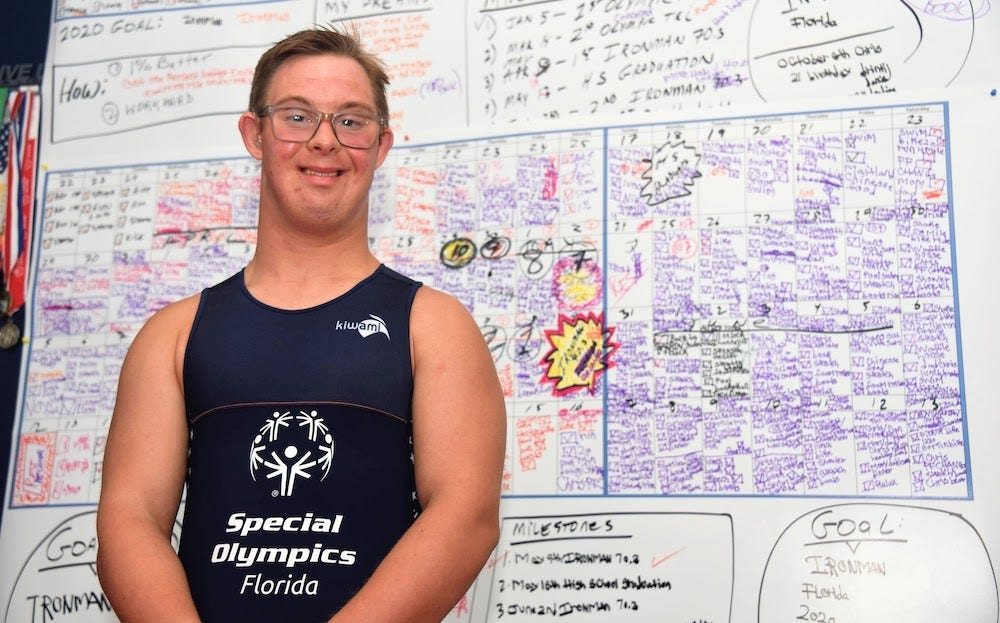
The 23-year-old just made history by completing the Ironman World Championship in Kona. And this weekend, he’ll run the New York marathon.
He is definitely someone I am cheering on wholeheartedly.
Yours,
Michaela