
Navigating the Waves
Surfing for mental health

Dear Solution-aries,
Natalie Small looks at the ocean like a mirror. “How high are the waves today, the ones out there on the water and the emotional ones within me? Do I feel like jumping into the tide or rather just wet my toes? What do I want to discover in the ocean today? And what do I want to leave behind?”
These are questions she likes to ask at the start of every session on Ocean Beach in San Diego, CA. I’m sitting in a circle with eight other participants and we write down our answers in our notebooks. Some will scribble their ideas with a colorful sharpie on the white blanket spread out on the sand: “Strength” “Joy” “Fun.” Then we all jump up to embody how we feel today.
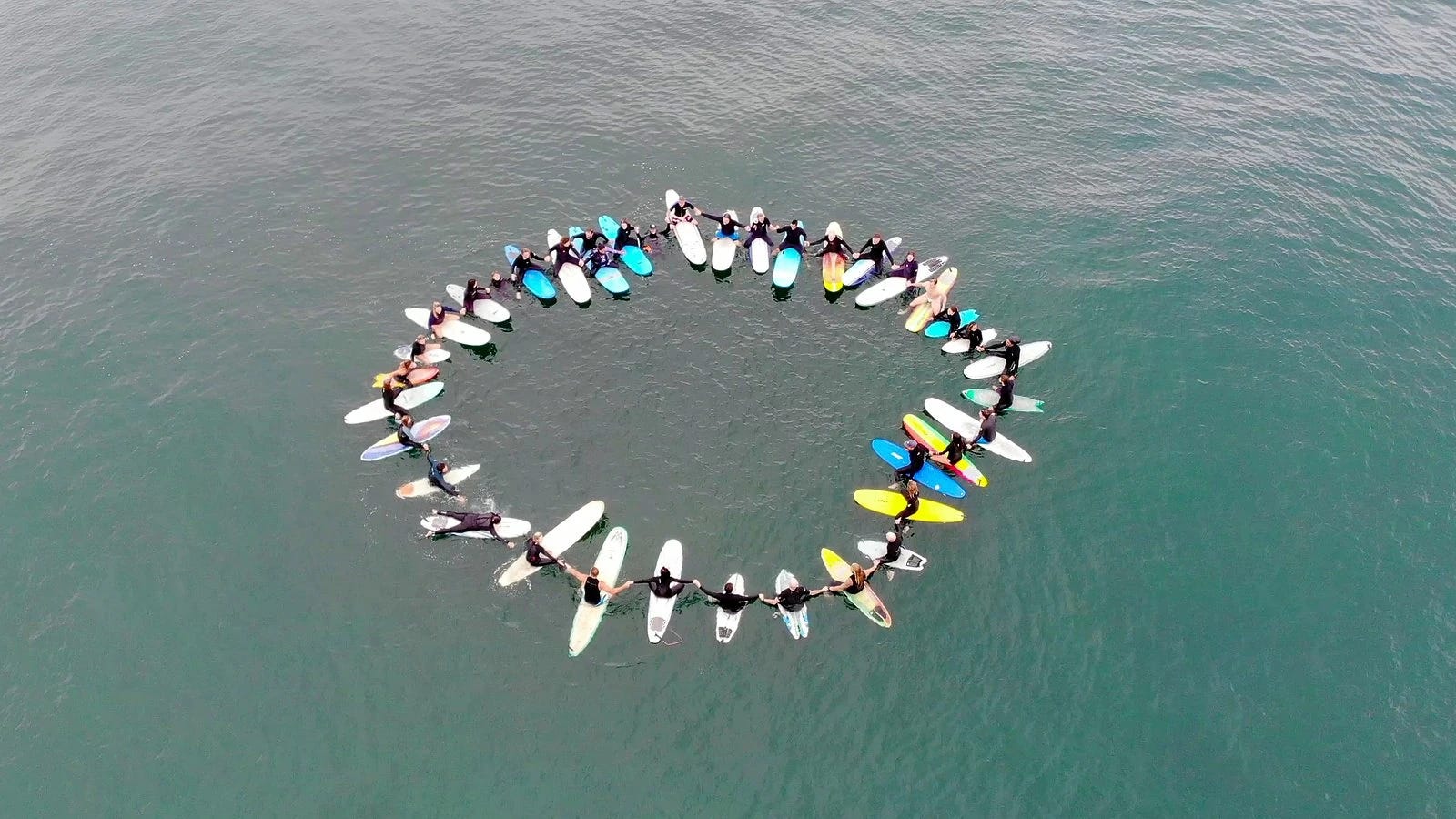
Natalie Small is a licensed marriage and family therapist as well as a surf coach. For the last ten years, she has been combining both: She takes her clients to the sea with her nonprofit Groundswell. “When we talk about navigating the waves, we connect it to how we navigate the emotional ups and downs within us,” the therapist says. “When we teach surfing, we don’t just teach the physical know-how, but we connect every movement to the breath and mindfulness.”

When I first heard about surf therapy, I was skeptical. But then I learned that surf therapy is being embraced as a surprisingly effective treatment for depression, anxiety and trauma.
The US Navy in San Diego has been offering it since 2008, and the British Health Service officially recognized it as a standard therapy in 2020. More than 130 organizations are members of the International Surf Therapy Organization (ISTO), offering surf therapy in 30 countries on six continents, from Scotland to South Africa, New Zealand to Mexico. As ISTO director Kris Primacio likes to put it, “We’re swapping the couch for the surfboard.”
What exactly is it about surf therapy that unleashes healing powers? Is it the adrenaline rush of catching a wave, being physically active in nature, the mindfulness needed to balance on the board or a combination of all these factors? Kristen Walter, a psychologist at the Naval Health Research Center and San Diego State University, received a $1 million grant from the Navy to research surf therapy for military personnel. “We see immediate benefits,” Walter confirms. “Posttraumatic stress, depression and anxiety decrease significantly.” Walter emphasizes that the effect on positive emotions is particularly noteworthy. “With depression and posttraumatic stress, people often are unable to feel joy. The fact that the participants feel more positive emotions is a unique aspect of surf therapy we don’t usually observe with other forms of therapy.”
About 15,000 clients participate in surf therapy every year worldwide. “We see positive changes that reach far beyond surfing,” Primacio sums up the current state of research. “Like other physical activity, the sport improves cardiovascular health but also self-confidence, self-efficacy and social competence. We find that participants become more engaged in school, work and with their families. They sleep better and feel better.”
Read my full story about why surf therapy is sometimes more effective than talk therapy here.
Wishing you a joyful Labor Day weekend!
Michaela
Copyright images: Groundswell